Cultivating peace at home with Montessori
Hope you are doing ok out there. So many of us are having a hard time right now – the news cycle, war, feeling unsafe at school and in our own homes, climate concerns.
I was speaking last week at the Childhood Potential conference and this is what folks said made them feel scared about their child’s future.
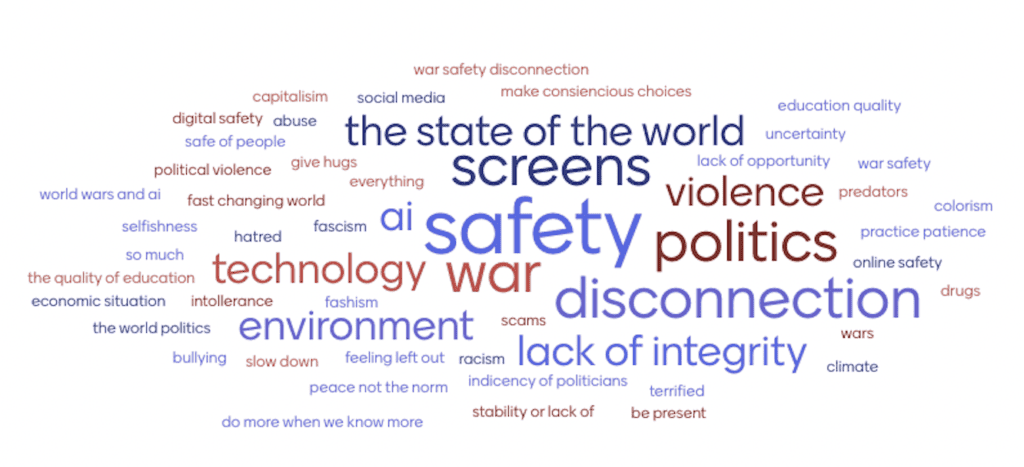
Definitely the most depressing start to a talk I ever did think of!
Yet, as we got into the talk, folks realised that what we can do to create peace at home with Montessori is to help our children find peace in themselves, peace with others, and peace with the environment. As well as finding and modelling peace in ourselves as the adults.
So I thought is might be helpful to share some of the ideas here in case you are feeling a little helpless too.
Cultivating peace in an uncertain world
Let’s start with a little background. Some of us might have heard about the Montessori peace table – a place where children can sit down in the Montessori classroom to resolve conflicts. There are many variations on this from a peace rose to a peace stone etc.
Yet Montessori peace education goes far beyond a peace table. In her book, Best Weapon for Peace, Erica Moretti proposes that Dr Montessori was not just creating a method of education; she was creating a path for peace.
Peace, in the Montessori sense, is not just about resolving conflict. It’s about helping the child come to peace with themselves, with others, and with the environment. And, not surprisingly, Dr Montessori was nominated six times for the Nobel Peace Prize.
“Averting war is the work of politicians; establishing peace is the work of education.”
– Dr. Montessori, Education and Peace
Cultivating peace in our children
We cannot find peace with others unless we first have peace within ourselves. From the time our child is born, they are exploring the question “Who am I?” They build their sense of self by interacting with the world and discovering what they are capable of – a baby batting a ball and seeing it move, a toddler planting and caring for a seed, a preschooler making pancakes for breakfast.
We can help them find peace in themselves by:
- giving our child real opportunities for independence, autonomy, and meaningful contribution
- setting up activities that are “just right” – not too easy, not too hard – so that the child becomes more regulated, focused, and at ease
- creating a calm, peaceful, ordered environment
- providing psychological safety – a space at home where their nervous system can relax
- helping our children understand who they are, eg, reading books with people who look like them, have the same family structure, exploring our culture with them (from food to dance to art to community)guiding them to find their cosmic task, ie, their purpose
Cultivating peace with others
In 2026, my hope is we are going to hear more about community – and not just independence – in Montessori. That is our ultimate aim, to be able to be ourselves in community with others.
To help our children to cultivate peace with others, we can:
- practice grace and courtesy – learning social graces to live in society with others like practicing gratitude, knowing how to interrupt politely (they can place their hand on our shoulder to let us know they have something to tell us), and respecting other people’s work
- help them to understand other people and their experiences – Rudine Sims Bishop talks about books being “mirrors, windows, and sliding doors”; we can take part in different community events; we can try food/dance/art from other cultures etc
- learning how to deal with conflict – listening to both sides, brainstorming solutions, making a repair if needed, and coming up with a plan that works for everyone. Over time, children learn responsibility, empathy, and how to work collaboratively with others.
- having opportunities to help others – foster a culture of volunteering or helping an elderly neighbour/relative or donating money/time for a cause that is important to us or making donations as a family or helping someone in the street
Over time, our child is learning how to live in community, understanding that “my freedom ends where yours begins” (a quote attributed to various sources and one of my favourites right now).
It may seem far away right now, but between 6-12 years old we may even see our child do something for the greater good, choosing something they don’t want because it is better for everyone.
Cultivating peace with the environment
Children also need to feel connected to the world around them. Young children are sensorial learners, and nature offers endless opportunities to connect through touch, smell, sound, and movement. When children feel part of the natural world, care for it grows naturally.
As children get older, we can explore the interconnectedness of all things and our responsibility toward the Earth. Beyond the 3 ”r’s” (reduce, reuse and recycle), we can add a 4th “r” for regeneration – leaving the world better than we found it.
You can find lots of ideas in this article here.
Our role as adult in creating peace at home with Montessori
Perhaps the most important work we can do is our own. Children absorb not only our words, but how we live – how we care for ourselves, how we speak to others, how we handle frustration, how we connect with the environment.I invite you to consider:how do we bring peace to ourselves?how do we model peace with our child/others?how do we connect and care for the environment?Montessori doesn’t ask us to be perfect parents and carers. It asks us to be intentional, to reflect, to be willing to repair when we get it wrong.
What is possible?
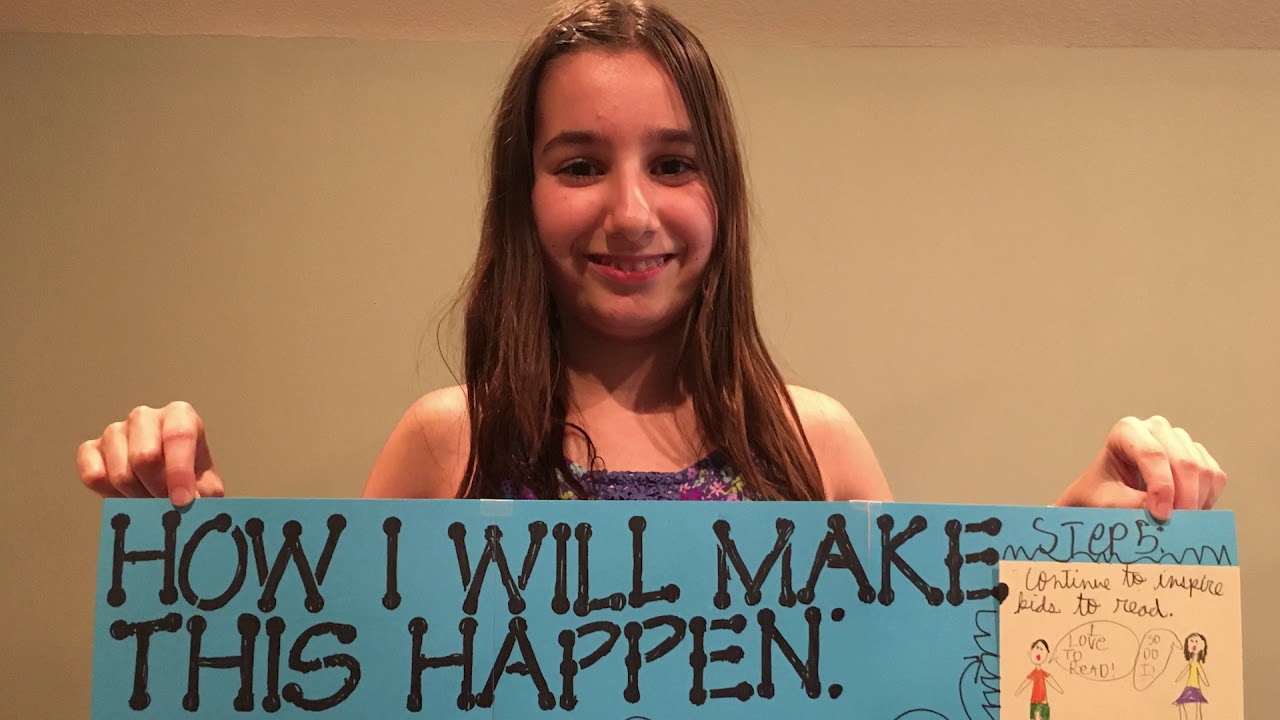
The Montessori Model United Nations is a beautiful example of what is possible when we sow these seeds of peace at home and at school. Watch this video below to see what is possible when we help to cultivate peace the Montessori way.
A parting question for you
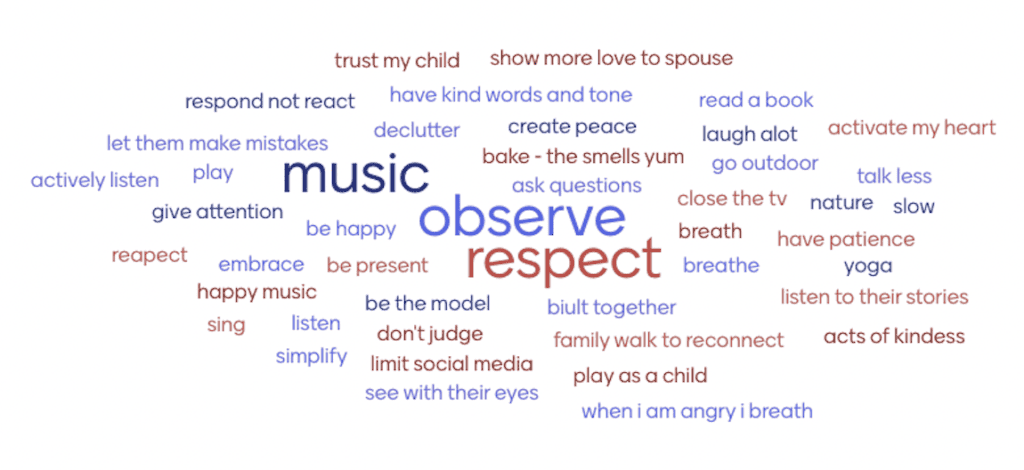
At the end of the Childhood Potential presentation, I asked the viewers what is one small thing you can do this week to create more peace at home? I’ll leave you with that same invitation.
Here’s a few ideas from the participants – these may seem small things, but they are things we have control over when the rest of the world is out of our control and which lay a foundation of peace in our homes.
Additional resources
- Education and Peace, Dr. Maria Montessori
- The Best Weapon for Peace, Erica Moretti
- Unconditional Parenting, Alfie Kohn
- Anti-Bias Education for Young Children and Ourselves, Louise Derman-Sparks & Julie Olsen Edwards
- Braiding Sweetgrass, Robin Wall Kimmerer
- Montessori Model United Nations (MMUN)
- If you’d like to watch the full talk Cultivating Peace in an Uncertain World: A Montessori Approach for Families, I believe you can access it by signing up for the VIP version of the Childhood Potential Conference, which includes session replays and additional resources.
Remember, peace is not the absence of conflict – it is inner regulation, meaningful connection, and a sense of purpose. All things we have some control over. Let’s start by creating peace at home with Montessori.
* Some links in this post may be affiliate links
Simone Davies is an experienced AMI Montessori educator since 2004. Simone is the author of “The Montessori Toddler” and co-author of “The Montessori Baby” and “The Montessori Child” books, comprehensive guides to raising children in a Montessori way. She is the founder of Jacaranda Tree Montessori in Amsterdam for families with children under 4 years. She also has a popular blog, instagram and podcast “The Montessori Notebook” and is mother to two young adults.